

The Black Box Problem: What an API Actually Is - and Is Not
The Black Box Problem: What an API Actually Is - and Is Not
API is one of those terms people repeat as if everyone received the same secret orientation packet. The standard definition - application programming interface - is technically correct and emotionally useless. It tells you what the letters mean while leaving the real question untouched: What program am I actually talking to?
The useful answer is that an API is a contract and a controlled interface. You provide a request in an agreed format. The system behind the interface performs some work. It returns a response in the format it promised. The machinery can be elegant, ancient, local, remote, or held together by the digital equivalent of duct tape. If the contract is honored, your code can use it.
Watch the full Deep Dive Classroom explainer
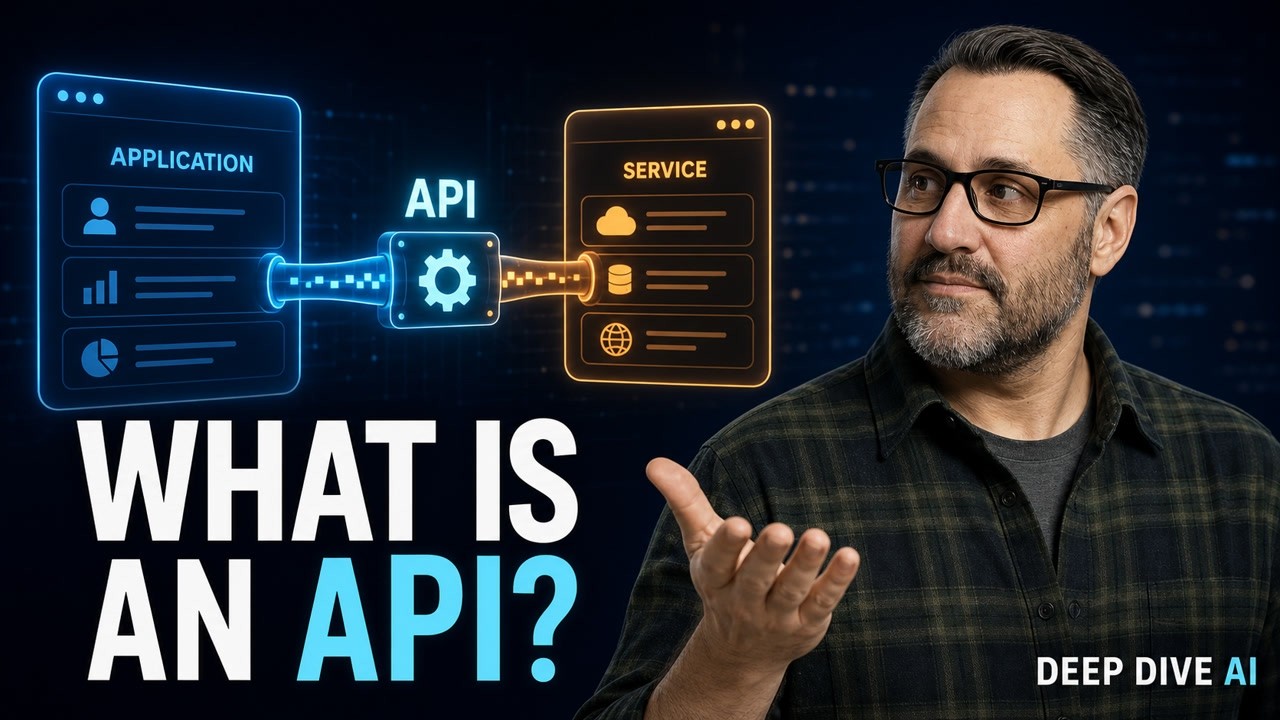
The handle, not the hammer
Think about a hammer. The steel head does the heavy work, but the handle is the part designed for you to grab. An API is the handle. It exposes the useful actions while keeping you away from the complicated implementation.
A car makes the same point. You turn a steering wheel and press pedals. You do not directly manipulate fuel injection, brake pressure, and steering geometry. The controls translate simple instructions into complicated behavior. You can drive without becoming an automotive engineer because the interface hides machinery you do not need to operate directly.
Software APIs provide that same layer of abstraction. They let one piece of software use another system's capabilities without needing access to every gear and wire inside it.
The API contract
The contract can be summarized this way: Give me this input, and I will give you that output. The caller must use the correct action, include required information, and follow the expected format. The provider agrees to return a documented result or an error that explains why the request failed.
This creates a stable boundary. The provider can rebuild the internal system without forcing every customer to rewrite their software, provided the public contract stays intact. That separation is why APIs allow modern software to grow without every component becoming permanently welded to every other component.
The restaurant analogy
The familiar restaurant analogy works because it separates the customer from the kitchen:
- The customer wants a result.
- The menu defines valid requests.
- The waiter carries the structured request and returns the response.
- The kitchen contains the hidden implementation.
You do not enter the kitchen and explain how to prepare the meal. You choose from the available actions, provide the necessary details, and wait for the result. The analogy is useful as long as you remember one thing: the kitchen is not always on the internet. It may be inside the browser, the operating system, a software library, or the same application.
Three common API flavors
Web or service APIs
These usually expose network endpoints. A program sends an HTTP request and receives data rather than a finished webpage. A successful request may return a status such as 200 OK with data formatted as JSON or XML. Weather, maps, payments, and social platforms commonly expose this kind of API.
Browser or platform APIs
These capabilities are already built into an environment. The Web Audio API, for example, lets JavaScript use the browser's internal audio engine. There is no mystery audio application waiting to be downloaded. The browser you already opened is the program behind the interface.
Library or software APIs
A code library exposes selected functions for other code to call. The interaction can happen entirely on one computer without a network request. The contract still exists even though the request never leaves the machine.
What an API is not
- An API is not automatically a database.
- An API is not automatically a remote server.
- An API is not the entire application.
- An API is not unrestricted access.
- An API is not proof that the hidden system is sophisticated.
The black-box design is useful because it hides complexity, but the same curtain can hide weak processes. A polished interface can sit in front of old software or manual work. That does not automatically make the API useless; it means reliability, documentation, accuracy, and trust still matter.
Why ordinary users should care
APIs are why a travel app can compare information from many airlines, why a website can show a map without building a mapping system, and why an automation tool can move information between services. Each connection depends on a documented contract.
They can also improve efficiency. Instead of downloading a complete webpage filled with images, styles, and navigation, software can request only the raw data it needs. That saves processing, reduces bandwidth, and lets multiple systems present the same information in different ways.
Watch the 75-second version

The takeaway
An API is the usable boundary around capability. It tells you what you may request, how to request it, and what kind of response will come back. You do not need to know every internal detail. You need to understand the contract and decide whether you trust the system honoring it.
If API documentation makes you feel as though you missed a meeting, remember three images: the hammer handle, the steering wheel, and the waiter. The jargon becomes much less impressive once you can see the interface doing its actual job.
Which technology term should Deep Dive Classroom decode next? Leave a comment on the video and subscribe to Deep Dive AI.
Recommended beginner resources
- Head First JavaScript Programming: A Learner's Guide to Modern JavaScript
- JavaScript Crash Course: A Hands-On, Project-Based Introduction to Programming
- Web Design with HTML, CSS, JavaScript and jQuery Set
As an Amazon Associate I earn from qualifying purchases.


Comments
Post a Comment